

Fundamentals of AI Thinking
Reading time: approx. 5 min
Alright, welcome to the first moment in How AI Models Think! Here we will dive into how these AI models actually work, without complicating it with math and advanced technology. The goal is simple: you should understand AI well enough to use it smartly in your teaching.
1. AI is advanced pattern recognition and probability calculation
So when you open ChatGPT and type a question, you get back a really good answer. It might seem like magic, but it is actually just advanced statistics and pattern recognition. The AI model has been trained on enormous amounts of text, images, and audio. During that training, it learned to recognize complex patterns and relationships. When you give it a prompt, it uses all that knowledge to predict what most likely should come next.
Important to remember: AI models do not "think" like you and I. They generate answers based on statistical probability, not because they understand or have their own opinions.
2. Training vs. when you use the AI
To understand how AI works, we need to distinguish between two things:
- Training: This happens before you get to use the model. AI companies feed the model with enormous amounts of data and adjust millions of settings so it becomes as good as possible at predicting the next word. This process requires incredibly powerful computers and costs millions.
- When you use it: When you type in ChatGPT, the model uses all those settings that were fixed during training to quickly calculate what it should answer. This can happen in the cloud (like ChatGPT) or on your own computer if you run AI locally.
3. Tokens: AI's LEGO bricks
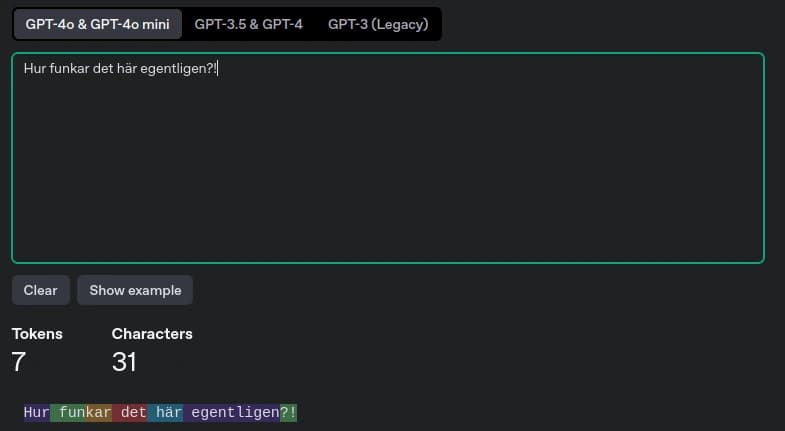
Now we come to something really important: tokens. AI models do not read text like you and I do. They must first chop up the text into small pieces called tokens. A token can be a whole word, a part of a word, or even just a space. The word "understanding" might be split into "under", "stand" and "ing".
- Why tokens?: This way, the AI can handle all languages and even words it has never seen before, by just breaking them down into pieces it recognizes.
- Important for you: Longer text means more tokens. And more tokens means the AI has to work harder and can even "forget" things you wrote early in your prompt.
Think of tokens as LEGO bricks: the AI model builds sentences by putting the right "pieces" together in the right order.
Test it yourself!: Check how tokens work here: https://platform.openai.com/tokenizer.
4. Just like autocomplete on your phone, but much better
You know when you type on your phone and it suggests the next word? "I would like to drink a cup of..." and then it suggests "coffee" or "tea". AI models work the same way, but on steroids:
- They have been trained on billions of sentences from the internet and books
- They have learned which words usually come after each other
- They can create completely new texts, not just suggest individual words
Here's the important part: ChatGPT, Claude, and similar tools are fundamentally guessing machines. They literally guess which next word should come, based on everything they have learned.
Here's how it works:
- The AI reads your prompt plus everything it has already written
- Calculates the probability for all possible next words
- Chooses the most likely word
- Adds it and does the same thing again
When ChatGPT writes "I would like to drink a cup of coffee," it has not planned the whole sentence. Each word is a new guess based on what came before.
This explains why:
- AI sometimes changes direction in the middle of an answer
- You can get different answers to the same question
- It is so important to write good prompts
When you write a prompt, you are really trying to get the AI to guess the right things. Your prompt steers what it will guess next.
5. What does this mean for you in the classroom?
Now that you understand how AI works, you can use it much smarter:
- Too long prompts get messy: If you write very long instructions at the beginning, the AI can "forget" them when it gets to the end. This is because of the token limit.
- Short and clear works best: Be specific and concise. Every word in your prompt affects what the AI will guess.
- When AI makes things up: Sometimes AI answers what sounds most likely, not what is true. This is called "hallucinations" and happens because it is just guessing based on patterns.
6. Test your understanding
Before we move on, think through this:
- Think of something you want your students to use AI for. How would you write the instructions as short and clear as possible?
- Take the sentence "AI is a powerful tool" and consider how many tokens it might be divided into.
- If you get a bad answer from AI, how would you change your prompt based on what you learned about tokens and guessing?
Next moment: We dive deeper into tokens and teach you exactly how to count them and use that knowledge to write even better prompts.